
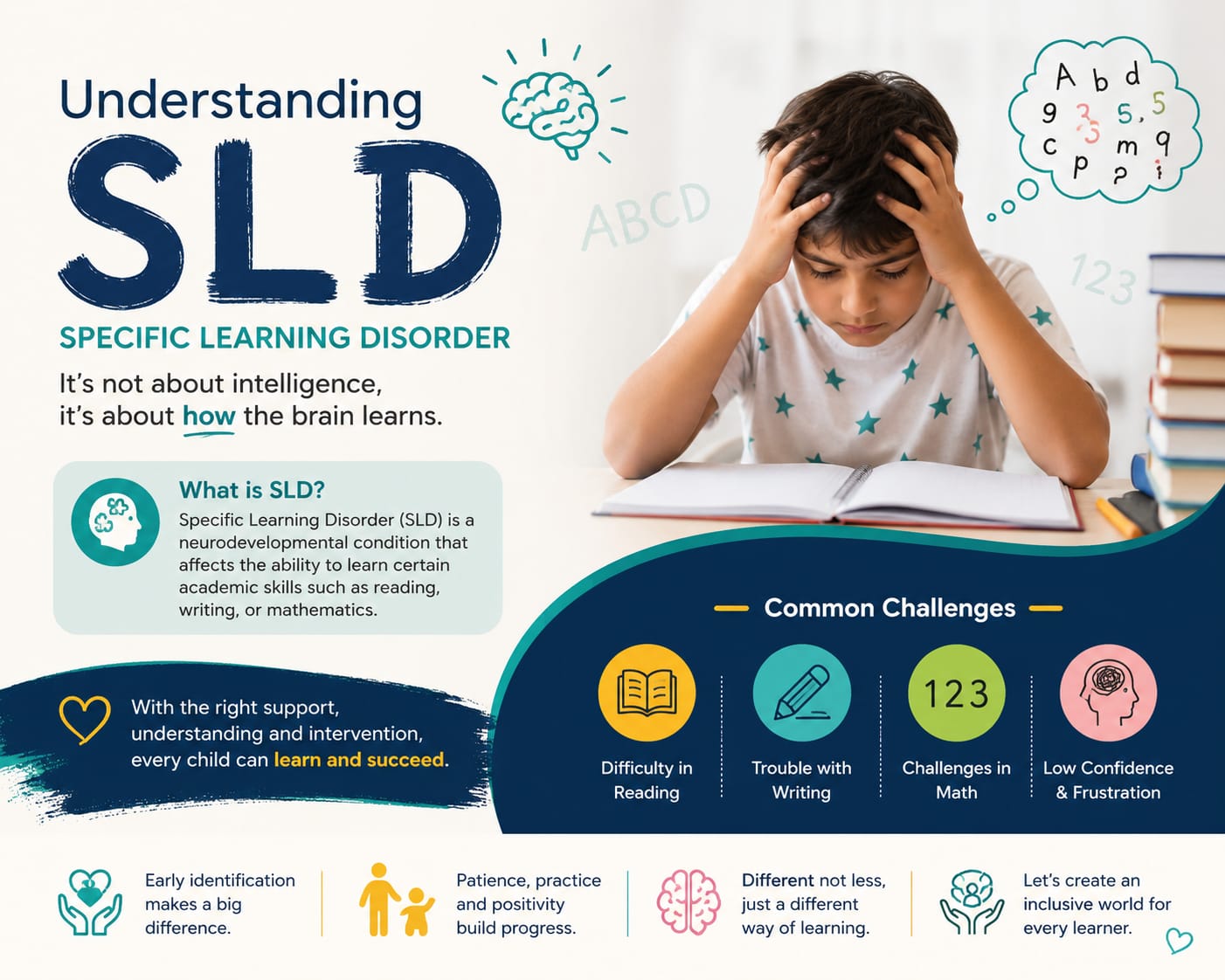
Every child learns differently. Some children understand concepts quickly when they are explained verbally but struggle to read, spell, write or work with numbers. When these difficulties are persistent and significantly affect academic progress, the child may have a Specific Learning Disorder (SLD).
SLD is not caused by laziness, poor parenting or low intelligence. It is a neurodevelopmental condition that affects how the brain processes particular types of academic information. With timely assessment, suitable teaching methods and consistent support, children with SLD can develop their skills and succeed academically and personally.
What is Specific Learning Disorder?
Specific Learning Disorder is characterised by persistent difficulty learning and using one or more academic skills. The main areas affected are:
- Reading
- Written expression
- Mathematics
The difficulties usually become noticeable during the school years. However, some children compensate for them until academic demands increase in higher classes.
A child may experience difficulty in only one area or in a combination of areas. SLD is different from intellectual disability because children with SLD can have average or above-average intelligence. The condition affects particular learning processes rather than the child’s overall ability to understand and learn.
Types of Specific Learning Disorder
SLD with impairment in reading
This is commonly associated with the term dyslexia. A child may experience:
- Slow or effortful reading
- Difficulty reading words accurately
- Trouble connecting letters with their sounds
- Difficulty understanding written passages
- Problems with spelling
- Avoidance of reading aloud
SLD with impairment in written expression
Difficulties involving writing are sometimes described using the term dysgraphia, although a professional assessment is needed to understand the exact nature of the problem.
The child may have difficulty with:
- Spelling
- Grammar and punctuation
- Organising ideas in writing
- Constructing complete sentences
- Producing written work at the expected speed
- Expressing knowledge effectively on paper
Poor handwriting alone does not necessarily indicate SLD. Handwriting difficulties may also be associated with motor coordination, attention or other developmental factors.
SLD with impairment in mathematics
Persistent difficulty learning and using mathematical skills is sometimes called dyscalculia. Possible signs include:
- Difficulty understanding quantities and number relationships
- Trouble remembering basic arithmetic facts
- Confusion with mathematical symbols
- Slow or inaccurate calculations
- Difficulty following the steps of a mathematical problem
- Problems applying mathematics in everyday situations
Common signs of SLD
The signs can differ according to the child’s age, educational level and area of difficulty.
During the early school years
- Difficulty recognising letters or matching letters with sounds
- Trouble identifying rhyming words
- Slow development of reading and spelling skills
- Reversing or confusing letters beyond the expected learning stage
- Difficulty remembering sequences
- Problems learning number concepts
- Taking considerably longer to finish schoolwork
During the later school years
- Reading slowly or avoiding reading
- Frequent spelling errors
- Difficulty understanding written instructions
- Trouble taking notes or copying from the board
- Disorganised written answers
- Difficulty remembering multiplication tables
- Poor performance in timed examinations
- A noticeable difference between verbal answers and written work
Children who repeatedly struggle may become frustrated, anxious or reluctant to attend school. Some may describe themselves as “not intelligent,” while others may hide their difficulties by avoiding tasks or displaying challenging behaviour.
These emotional or behavioural responses should not automatically be mistaken for a lack of interest. They may reflect the stress of repeatedly facing tasks that the child finds unusually difficult.
What does not cause SLD?
SLD is not simply the result of:
- Low intelligence
- Laziness or lack of motivation
- Inadequate parenting
- Vision or hearing difficulties
- Emotional problems alone
- Irregular schooling or insufficient instruction
- Limited familiarity with the language of instruction
Some of these factors can nevertheless affect academic performance. A comprehensive assessment is therefore important before reaching a conclusion.
How is SLD assessed?
There is no single test that should be used by itself to identify SLD. Assessment generally involves collecting information from multiple sources, including:
- Developmental, medical and educational history
- Parent and teacher observations
- School reports and samples of academic work
- Assessment of intellectual and cognitive abilities
- Standardised tests of reading, writing and mathematics
- Evaluation of the child’s response to previous academic support
- Screening for emotional, behavioural or attention-related concerns
- Consideration of vision, hearing, language and educational opportunities
The purpose of an assessment is not merely to assign a label. It is to develop a detailed understanding of the child’s strengths, areas requiring support and most suitable learning strategies.
A qualified professional should interpret the assessment results alongside the child’s history, classroom functioning and educational background. SLD should not be self-diagnosed using an online checklist.
Can SLD occur with other conditions?
Yes. SLD may occur alongside other developmental or psychological conditions, such as:
- Attention-Deficit/Hyperactivity Disorder
- Anxiety
- Speech or language difficulties
- Developmental coordination difficulties
- Autism spectrum disorder
- Emotional or behavioural concerns
When more than one condition is present, each concern should be assessed carefully so that support can be planned according to the child’s complete needs.
How can children with SLD be supported?
SLD is not addressed through one standard method. Support should be individualised according to the child’s profile.
Helpful interventions may include:
- Structured and systematic remedial education
- Explicit teaching of reading, spelling, writing or mathematical skills
- Breaking complex tasks into smaller steps
- Repeated practice with constructive feedback
- Multisensory learning methods
- Visual schedules and written instructions
- Assistive technology, where appropriate
- Additional time for assignments and examinations, when approved
- Collaboration between parents, teachers and professionals
- Psychological support for anxiety, frustration or reduced self-esteem
Medication does not treat SLD itself. However, a medical professional may recommend treatment when a child has a separate co-occurring condition requiring clinical care.
How parents can help at home
- Appreciate effort rather than focusing only on marks.
- Avoid comparing the child with siblings or classmates.
- Give short and clear instructions.
- Divide homework into manageable portions.
- Encourage regular breaks during demanding tasks.
- Use stories, games and practical activities to make learning engaging.
- Help the child discover strengths in art, sport, music, communication, problem-solving or other areas.
- Maintain regular communication with teachers.
- Seek professional guidance when difficulties persist.
Most importantly, remind the child that needing a different way of learning does not mean having less potential.
When should parents seek an assessment?
Consider consulting a qualified professional when:
- Academic difficulties continue despite regular teaching and targeted help
- The child performs significantly below expectations in reading, writing or mathematics
- Homework regularly causes considerable distress
- Teachers report persistent learning concerns
- The child begins avoiding school or losing confidence
- There is a substantial difference between oral understanding and written performance
- Learning difficulties interfere with everyday functioning
Early identification can help families and schools introduce appropriate support before repeated academic difficulties begin to affect emotional well-being.
Learning differently does not mean learning less
Children with SLD can be creative, capable and successful. Their difficulties do not define their intelligence or future. Accurate assessment, patient teaching and emotional encouragement can help them understand how they learn best.
At Dr. Anusha Reddy Minds Clinic, we provide psychological and learning-disability assessments to understand a child’s cognitive and academic profile. Guidance is tailored to the needs of the child, parents and school.
Book an appointment
Dr. Anusha Reddy Minds Clinic
Hafeezpet and Nallagandla, Hyderabad
Phone: +91 85000 03142
Email: info@dranushareddymindsclinic.com
Website: dranushareddymindsclinic.com
This article is intended for general awareness and education. It is not a substitute for an individual psychological, educational or medical assessment.
One Comment
Informative Article.
Thank you ma’am.